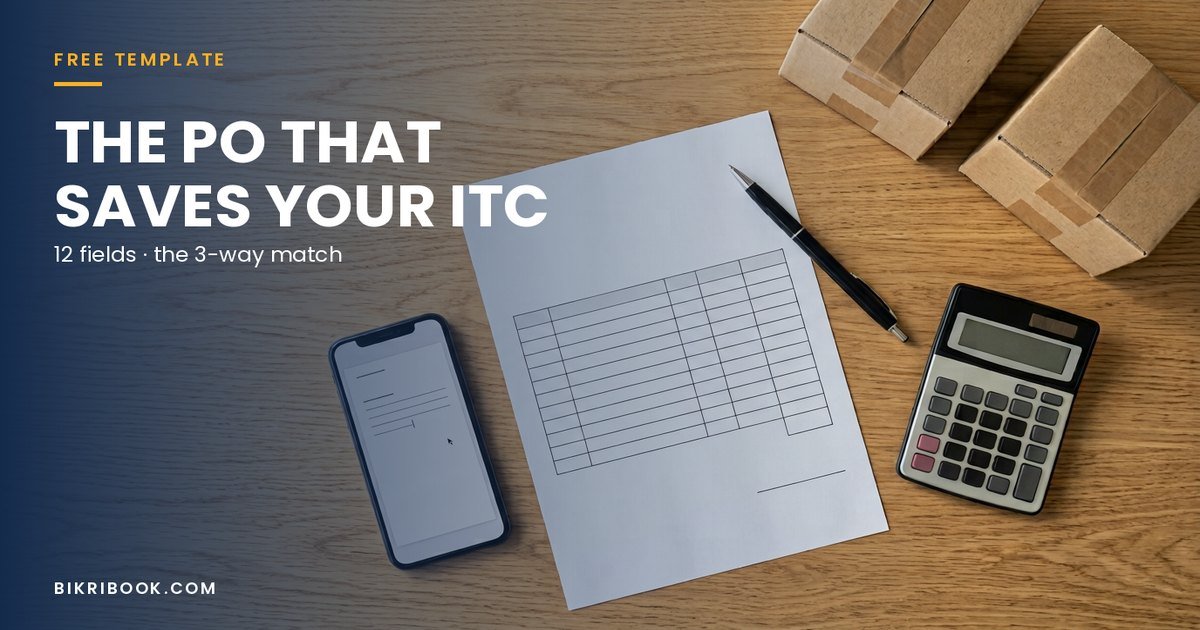
Purchase Order Format for Small Manufacturers & Distributors (Free Template)
A purchase order format you can copy today: 12 mandatory fields, how a PO differs from a purchase bill, and why the 3-way match protects your GST credit.
Platform Owner · · 6 min read
Quick answer: A purchase order (PO) is a buyer's written offer to a supplier — it lists items, quantities, agreed rates, taxes, delivery terms and payment terms before goods are supplied. It is not a tax invoice and carries no input tax credit. Its value is control: a PO creates the reference against which you match goods received and the supplier's bill, so nothing is paid or claimed twice.
Small businesses often skip POs because they feel like paperwork for large companies. In reality the PO is the cheapest internal control you can adopt. It is the difference between "the material arrived" and "the material we ordered, at the price we agreed, arrived."
What is the difference between a purchase order, a purchase bill and a quotation?
| Document | Issued by | Purpose | GST |
|---|---|---|---|
| Quotation | Supplier | Price offer, no commitment | Shows rate, no tax liability |
| Purchase order | Buyer | Binding order to supply | Taxes shown for reference |
| Goods receipt note (GRN) | Buyer | Confirms what actually arrived | None |
| Purchase bill / tax invoice | Supplier | Demand for payment | GST charged; only this gives ITC |
| Delivery challan | Supplier or buyer | Movement of goods that are not a sale | None |
The only document that gives you input tax credit is the supplier's tax invoice. A PO proves intent. A GRN proves receipt. Both are evidence you will want when the department asks whether a purchase was genuine.
The 12 fields every purchase order must carry
- PO number and date, from a consecutive series
- Your business name, address and GSTIN
- Supplier's name, address and GSTIN
- Delivery address (often different from the billing address)
- Item description with HSN code, and your internal item code if you have one
- Quantity and unit of measure — pieces, kg, metres, boxes
- Rate per unit and the agreed discount
- Tax treatment — GST rate per line, CGST/SGST for intra-state or IGST for inter-state
- Total order value in figures and words
- Delivery date or delivery window, and who bears freight
- Payment terms — advance %, credit days, and the exact due date
- Authorised signatory and terms of the order (quality, rejection, replacement)
Add a delivery/shipping instruction and PO validity if the order is large. Add a job work or processing clause if material is being sent out for processing.
Purchase order format (copy-paste template)
PURCHASE ORDER
Buyer: [Business name] · [Address] · GSTIN: [GSTIN] · Phone: [Number]
Supplier: [Name] · [Address] · GSTIN: [GSTIN]
PO No.: PO/2026-27/0157 · Date: 25 Nov 2026
Deliver to: [Godown / factory address]
Taxable value: ₹71,000 · IGST @18%: ₹12,780 · Order total: ₹83,780
Payment terms: 30 days from delivery, subject to inspection
Delivery by: 10 Dec 2026 · Freight: To buyer's godown, included
For [Business name] — Authorised signatory: __________
| # | Description | HSN | Qty | UOM | Rate (₹) | GST % | Amount (₹) |
|---|---|---|---|---|---|---|---|
| 1 | MS angle 40x40x5 | 7216 | 1,000 | Kg | 62.00 | 18 | 62,000 |
| 2 | Hex bolts M10 | 7318 | 2,000 | Pcs | 4.50 | 18 | 9,000 |
Keep the numbering consecutive. A PO series with gaps is exactly what an auditor asks about.
Why the 3-way match matters more than the PO itself
The PO is one leg of a three-legged control:
Purchase order ↔ Goods receipt note ↔ Supplier's tax invoice
All three must agree on quantity, item and rate before payment. When they do not, one of four things has happened, and every one of them costs you money:
- You were over-billed — supplier invoiced a higher rate than agreed
- Short supply — invoice quantity is more than what actually arrived
- Duplicate bill — the same delivery invoiced twice, which is a common fraud in running-account suppliers
- Wrong GST — a rate different from what the PO specified, which later breaks your GSTR-2B match
Shops without POs discover these problems at year-end, when the supplier has already been paid and the reconciliation is three months old.
How the purchase order protects your GST credit
Input tax credit is not automatic. It depends on four things lining up:
- The invoice appears in your GSTR-2B, which is generated from the supplier's filed GSTR-1.
- The supplier is GSTIN-active and has actually paid the tax.
- The invoice is for your business, not personal use — blocked credits under Section 17(5) are not claimable.
- You have evidence the goods were received — and this is where the PO and GRN earn their place.
If a supplier raises an invoice for goods you never ordered or never received, you have a credit that will be questioned and, in a mismatch case, reversed. A PO with no matching GRN is the fastest way to spot that.
Also check the invoice's ITC claim window: credit for a financial year must be claimed by 30 November of the following year or with the annual return, whichever is earlier. Purchase records that are complete in November make that deadline painless.
Purchase orders for manufacturers: two extra uses
1. Job work control. When you send material to a job worker, the challan plays the role of the PO — it defines exactly what is being sent and what must come back. Without a reference, returned goods get costed wrongly and the reconciliation never closes. See job work challan format.
2. Rate discipline. Manufacturers buy the same raw material repeatedly. A PO series gives you a rate history per supplier and per item, which is the only way to know whether the price you paid in December was better than October.
Who should approve a purchase order?
For a small business the rule should be boringly simple:
- Owner approves anything above a set value (say ₹25,000)
- Purchase staff raise POs below it
- Nothing is ordered on a phone call without a PO number
- Nothing is paid without a PO and a GRN
This is also what makes your business bankable. Lenders and buyers doing due diligence read a PO trail as evidence of process, not bureaucracy.
How BikriBook handles purchase orders
Raise a PO with your item master and GST rates, receive goods against it, and convert to a purchase bill in one step — with stock updating at the moment of receipt, and the purchase data landing in your GSTR-2B reconciliation. Item-wise purchase rate history is kept automatically, so you always know the last price paid.
See how inventory and purchase tracking works →
FAQs
Is a purchase order mandatory under GST?
No. GST does not require a PO. It is a commercial control document. However, it becomes important evidence of a genuine transaction if a purchase or ITC is ever questioned.
Does a purchase order give me input tax credit?
No. Only the supplier's tax invoice does, and only when it appears in your GSTR-2B with valid GSTIN and correct tax. The PO supports the claim; it does not create it.
What is the difference between a purchase order and a purchase bill?
The buyer issues a PO before supply; the supplier issues the purchase bill (tax invoice) after supply. The PO is a commitment to buy; the bill is a demand for payment.
Can a small shop issue POs without software?
Yes — a numbered PO book or a Word template works to start. It stops working when you have multiple suppliers and need to match receipts, which is when a system pays for itself.
How long should purchase records be kept?
Keep invoices, POs and challans for at least 72 months (6 years) from the due date of filing the annual return for that year.
Raise POs, receive stock and convert to purchase bills in one flow. Track purchase rates automatically. Start 14-day free trial · Inventory features
Frequently asked questions
- Is a purchase order mandatory under GST?
- No. GST does not require a PO. It is a commercial control document. However, it becomes important evidence of a genuine transaction if a purchase or ITC is ever questioned.
- Does a purchase order give me input tax credit?
- No. Only the supplier's tax invoice does, and only when it appears in your GSTR-2B with valid GSTIN and correct tax. The PO supports the claim; it does not create it.
- What is the difference between a purchase order and a purchase bill?
- The buyer issues a PO before supply; the supplier issues the purchase bill (tax invoice) after supply. The PO is a commitment to buy; the bill is a demand for payment.
- Can a small shop issue POs without software?
- Yes — a numbered PO book or a Word template works to start. It stops working when you have multiple suppliers and need to match receipts, which is when a system pays for itself.
- How long should purchase records be kept?
- Keep invoices, POs and challans for at least 72 months (6 years) from the due date of filing the annual return for that year.